
Holmes County Release Date Types
A projected or tentative release date is a calculation made before custody ends. An actual release date records an event that already occurred. The two may match, but they answer different questions. FDC calculates a date for a sentenced state prisoner from the sentence, lawful jail credit, gain-time rules, and later changes. A Holmes County jail exit may instead turn on bond, recognizance, dismissal, time served, a judge's order, or a hold from another authority.
Pretrial custody has no FDC gain-time projection. A judge may set or change bond, yet release processing still has to occur at the jail. Likewise, a court order can explain the legal authority without proving the precise exit time. For a state prisoner, the public calculation is useful for planning but is not a release certificate. Transfer to another facility also ends custody at one location without returning the person to the community.
Scheduled versus actual: A displayed date is an estimate while custody continues. Confirm an actual release through the agency's event record after the date arrives.
Find Holmes County Release Dates
Choose the search route from the person's legal custody. Holmes Correctional Institution is an FDC state prison, while Holmes County Jail is operated by the sheriff. FDC's population data expressly excludes county-jail-only sentences and county probation. A person who bonded out after a local arrest may never appear in the state database. A person moved from the jail into FDC custody was transferred, not released.
- Identify the holding agency and whether the person is pretrial, serving a county sentence, or serving a Florida prison sentence.
- For an FDC prisoner, open the Inmate Population Information Search. Use the DC number when known, or search by name and aliases.
- Open each plausible detail record. Compare the DC number, date of birth, photograph, conviction, sentence, and location before reading its release field.
- For a Holmes County jail case, read the judgment and docket for sentence, jail credit, bond, and later orders. Then ask the jail for its calculated date or actual release event.
- After the expected date, verify the exit with the sheriff or FDC record. If another agency took custody, follow the receiving agency's system.
Name searches in FDC match the beginnings of names and may return many candidates. The alias option broadens them further. A DC number is the most precise input. Photo controls can suppress pictures in result lists for speed or limit results to records with a photo, while a matched detail may still contain one. Open the record instead of relying on a list row, then inspect sentence and offense history because separate cases or consecutive terms can make one isolated date misleading.
| FDC search field | Use in a Holmes County release date lookup |
|---|---|
| DC number | Most precise input for a person already known to the Florida corrections system. |
| Last and first name | Name prefixes can return broad results, so compare every plausible detail record. |
| Aliases | Expands the search beyond the committed name when the expected spelling produces no match. |
| Photo controls | Change whether result lists display or filter by photographs; they do not determine release status. |
The FDC search can change quickly and warns that the public result may not reflect the true current location, status, or release date. Use a near-term date as a lead for confirmation. The Holmes County released inmate search explains the full jail, court, FDC, federal, and records-request paths when the person's custody route is unclear.
Florida Labels for Holmes County Release Dates
Florida uses two labels that describe related parts of one calculation. The live FDC detail page calls its visible field “Current Release Date.” Florida Statutes section 944.275 calls the gain-time-based projection a “tentative release date.” The statute also requires a maximum sentence expiration date for a term-of-years prisoner, reduced by lawful credit. The tentative date results from gain time granted, restored, or forfeited and cannot be later than the maximum expiration date.
The portal's warning says a Current Release Date can change due to gain-time award, gain-time forfeiture, or review. “TO BE SET” means review is still pending. A life sentence can display “SENTENCED TO LIFE” rather than a routine calendar estimate. These exact labels should be read as written. Neither one proves a person has completed release processing.
The FDC detail example captured for the release field shows the live label and warning.
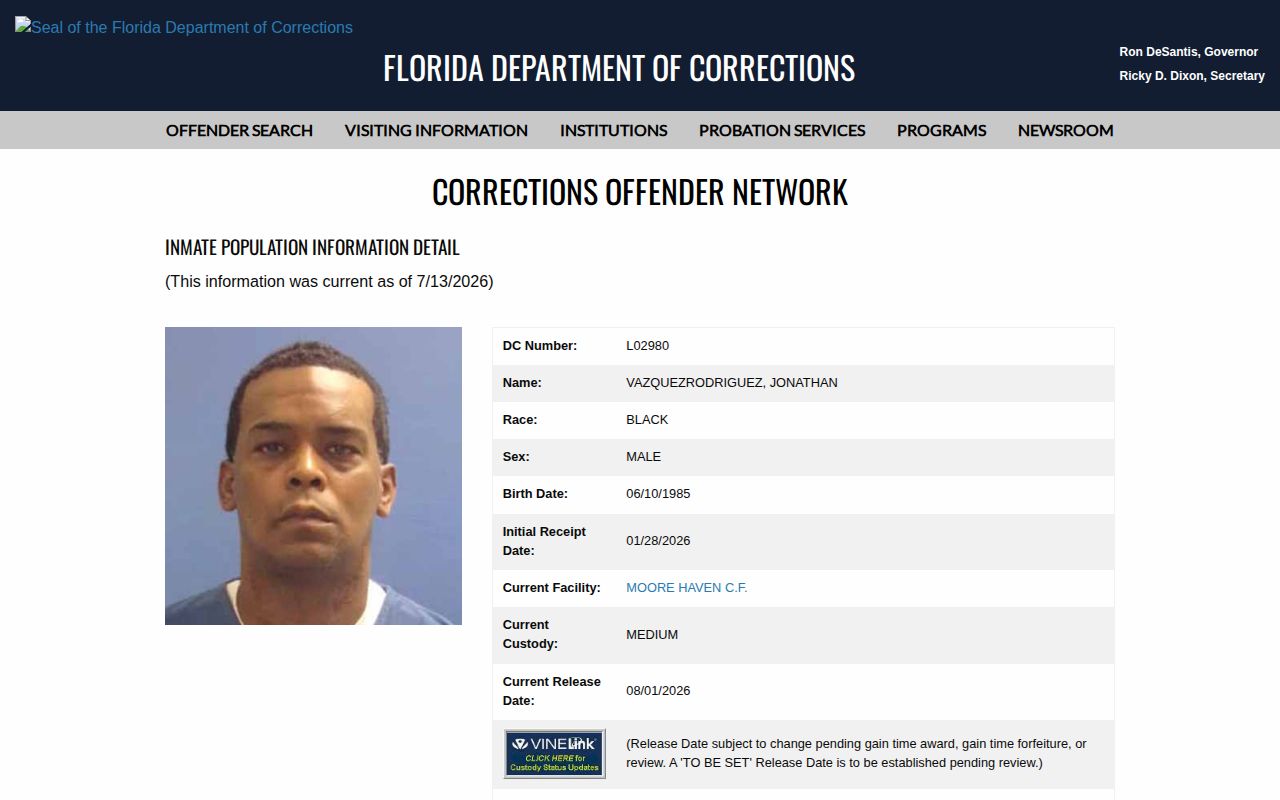
The warning beside the field is part of the record's meaning, so the date must not be copied without its change caveat.
Holmes County Release Dates and Gain-Time
Gain-time is credit that FDC applies under statute when calculating a state prisoner's tentative release date. It is not a single rule that permits a simple sentence-length subtraction. FDC must account for the offense date, sentence structure, lawful jail credit, statutory exclusions, granted or restored credit, and forfeiture. Multiple or consecutive sentences can further change the result.
For offenses committed on or after October 1, 1995, incentive gain-time generally cannot move release earlier than service of 85 percent of the imposed sentence. Court-awarded credit for time physically incarcerated counts toward that floor. For this cohort, incentive gain-time is generally capped at up to 10 days per month, subject to the floor and statutory exclusions. Older offense-date groups have different rules, including historical basic gain-time and different incentive caps. Life sentences do not become routine calculated dates through this framework.
Section 944.275 contains limited awards and detailed exclusions. It should be applied by FDC, not recalculated from a public sentence summary. The official tentative release date and gain-time statute is the source for the rule.
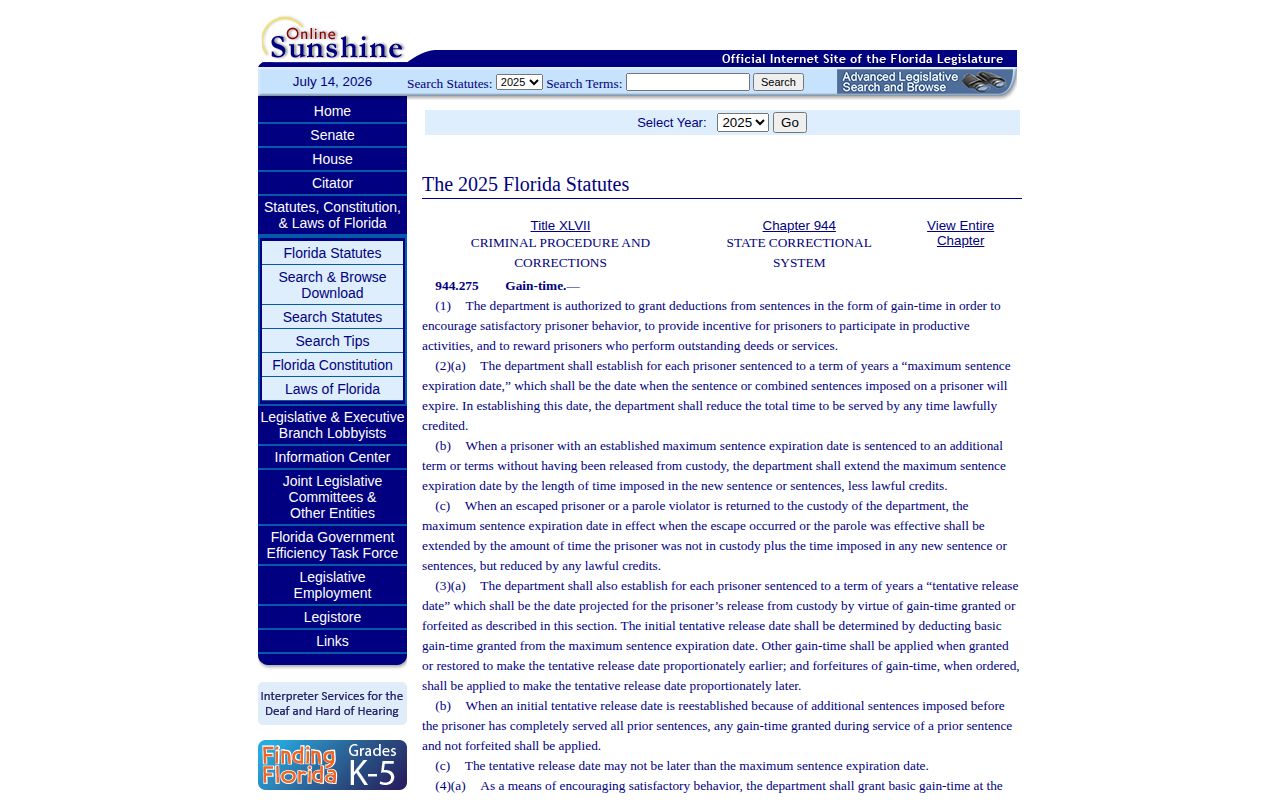
The statute shows why one statewide percentage cannot replace the date calculated in a specific FDC offender record.
Note: Do not apply FDC's prison gain-time formula to a Holmes County jail sentence unless the jail identifies a governing rule for that case.
Why Holmes County Release Dates Change
A tentative date can move in either direction while FDC applies later facts and legal events. A new detainer may not alter the end of an FDC sentence, but it can affect whether the person returns to the community when FDC custody ends. Parole or conditional-release action also needs its actual Commission order and current supervision record. A calendar listing or hearing agenda is not a release decision.
| Change factor | Effect on the release date or event |
|---|---|
| Gain-time award or restoration | Can move the tentative date earlier within the statutory rules and minimum-service floor. |
| Disciplinary forfeiture | Can move the calculation later. Section 944.28 authorizes forfeiture in specified circumstances. |
| Jail-credit correction | Lawful credit changes the time remaining and may alter the calculation. |
| New or consecutive sentence | Can extend custody beyond the date associated with one sentence or case. |
| Court amendment or revocation | Can change the sentence or return a supervised person to custody. |
| Detainer or hold | May cause transfer to another authority instead of community release. |
| Pending review | May produce “TO BE SET” until FDC finishes review. |
Florida Statutes section 944.28 addresses gain-time forfeiture. It does not support guessing how many days a named person will lose. The current FDC detail remains the best public calculation, followed by direct FDC confirmation when the date or legal consequence matters.
Supervision can affect how a reader describes the event without changing the fact that prison custody ended. The FDC Supervised Population Search may show Supervision Begin Date, Current Location, Current Status, Supervision Type, Scheduled Termination Date, and Community Supervision History. Those fields distinguish a person living in the community under an active term from someone fully discharged. County probation is separate and is not contained in the FDC inmate population search.
Holmes County Jail Release-Date Records
A Holmes County pretrial detainee does not have an FDC tentative date. Bond, recognizance, dismissal, a hold, and later court action control the exit. For a person serving a county sentence, read the judgment for the imposed term and jail credit, then ask Holmes County Jail for its own calculated date and any rule applied. The research found no published Holmes-specific county-jail gain-time or weekend-adjustment policy. None should be assumed from the state-prison formula.
Call 850-547-3681, option 2, with the full name, date of birth if known, booking or case number, and an approximate date range. Ask whether the date is a calculation or a completed event. Also ask whether the person went to the community, FDC, another county, or another authority. When documentary proof is needed, request the booking and release sheet with the actual release date and time, release authority, and receiving agency.
The Holmes Clerk court route can show bond, judgment, sentence, jail credit, probation, dismissal, or a later order. It normally does not establish the precise moment a person crossed the jail release desk. Pair the legal record with the agency's custody event.
Confirm Holmes County Release Dates
After a projected date arrives, check the correct agency record again. FDC's dedicated Inmate Releases Search updates nightly and can show a completed state-prison release. An official released detail may include both Release Date and Incarceration History Date Out-Custody, which together provide stronger evidence of the FDC exit. A community supervision record indicates the person left prison but has not necessarily completed the sentence or all supervision.
For a pending county or state event, Florida VINE can provide a custody-change alert. Registration should be made from the matched person record, and the notice should prompt a call to the sheriff or FDC. The Holmes County VINE inmate check explains how to compare the record and register without confusing the notification PIN with account verification.
A release alert is not a certified record. If the state detail omits the needed history, make a narrow FDC public-record request using the person's full name and DC number. For a local case, request the Holmes sheriff's existing booking, movement, or release record. If the exit led to another agency, use that receiving agency to establish the next custody status.
The FDC public-records route is the fallback for an existing date calculation, movement history, release detail, or order that the public search does not show. Name the exact record sought and identify the person by DC number. FDC reviews records under Florida public-records law, may redact exempt material, and can provide a cost estimate before preparing responsive records. It does not have to create a new calculation or answer a broad research question. A focused request for an existing record is more useful than asking the custodian to predict a release.
For an already completed FDC release, compare the release record's Release Date with Incarceration History Date Out-Custody. The official detail can also carry an information-current date, DC number, sentence history, detainers, and aliases. Matching the exit date to the custody-history field is stronger than quoting an earlier projection. When a detainer appears, read its agency, type, and cancellation information before deciding what followed the FDC exit.